
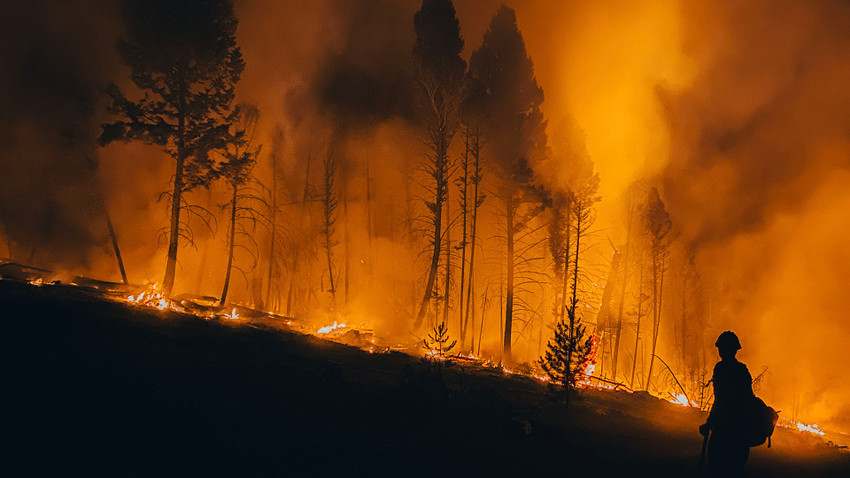
Wildland Firefighter Joe Beck Always has a Silky in His Pack
Born and raised on a cattle farm in Montpelier, Idaho, on the border with Wyoming, wildland firefighter Joe Beck grew up around Silky saws. “My dad has a Bigboy, and I always thought that it was pretty sweet. Every year, we’d take the Bigboy to get our Christmas tree.”
So when Beck decided to pursue a career in wildland firefighting, it was only natural he’d buy a Silky for his pack.
“I love the Gomboy. It fits perfectly in the pocket of my Mystery Ranch firefighting pack. I can even zip it in. It’s big enough to get the job done, but it weighs nothing, and it’s super convenient. Maybe a bigger saw would suit me better. But at this point, I’ve been using it for so long, it’s hard to think of switching.”
Beck says that everyone on his crew carries Silky saws, and he estimates that 75% of the firefighters he works with from other states carry Silky saws as well. “We carry so much weight in our packs. They’re loaded down with five to six quarts of water, food for the day (I live on tuna packets, crackers and granola bars), a first aid kit, extra PPE like earplugs, a radio and extra batteries, a fire shelter, electrolytes, extra gloves, a spoon or fork, a tourniquet. The Gomboy weighs nothing, and holy cow, do I use it a lot.”
Beck started fighting fires right out of high school. “It was just something to do–it seemed like a cool summer job from March to the end of October. It’s a job that laid me off each winter, so I could ski, which was perfect. Then my summer job turned into a full-time job I kept doing year after year. I worked my way up.”
Now 28 years old, Beck runs an engine, and he’s been at the job for 11 years. He’s still based in Montpelier, ID, where he works for the U.S. Forest Service. He’s traveled to every state in the West and beyond to fight fires and conduct prescribed burns: Nevada, Utah, California, Montana, Wyoming, South Carolina and Missouri.
Beck says he spends all of his time on engines (fire trucks) and hand crews. “When we’re making a firebreak, we always have chainsaws–usually two to a group of 15 firefighters. When we’re going direct, we’re building a line right against the fire’s edge and cutting trees to make a firebreak. Indirect is where the fire is too crazy or inaccessible. In that case, we go back to a feature where we can catch the fire and cut down a line of trees so that the fire can’t leap through the canopy.”
“Where my Silky comes in handy is after the chainsaws go through, there is always a branch or two, or some smaller trees that were missed that need to come down. I can tackle those jobs with my Gomboy. I don’t have to make the chainsaw crews hike back to fix something.”
“Other times, I’ll spread out monitoring the fire’s edge to make sure the fire doesn’t jump over our line. A lot of times Mother Nature doesn’t cooperate. Wind blows embers across the line, they land under a little tree, and ignite it. When embers cross the line and start a fire, but the chainsaws have already moved on, usually I can cut out four or five trees with my Gomboy so that we can dig a line around them and maintain the break. I use my Gomboy daily when I patrol up and down a line. I can pull the Silky and cut a branch here or there to make the line look good and do some quality control. Local fires are often caused by lightning striking a single tree. We see the smoke, we know where it is, we hike in and assess before we load troops and pack up chainsaws and everything else. A lot of times we’re able to get it under control using just our Silky saws.”
Beck doesn’t just bring his saw to work. He uses it in his off-time, too.
“I always take my saw on a drive, whether I’m hunting, camping, or doing something else. I keep a Gomboy in the secret center compartment of my truck. I’ve cut out trees that were blocking the road. I always throw it in my hunting pack. On super cold days, it’s nice to be able to cut some decent-sized wood for a fire instead of breaking twigs and having to stoke the fire every five minutes. If I’m just going for a day, I throw it in my pack. When I’m overnighting on hunting trips, I’ll clear a camp spot, and break out the Gomboy to cut firewood to cook dinner.”