
Ryan Jung: Who needs a snow saw when you have a Silky?
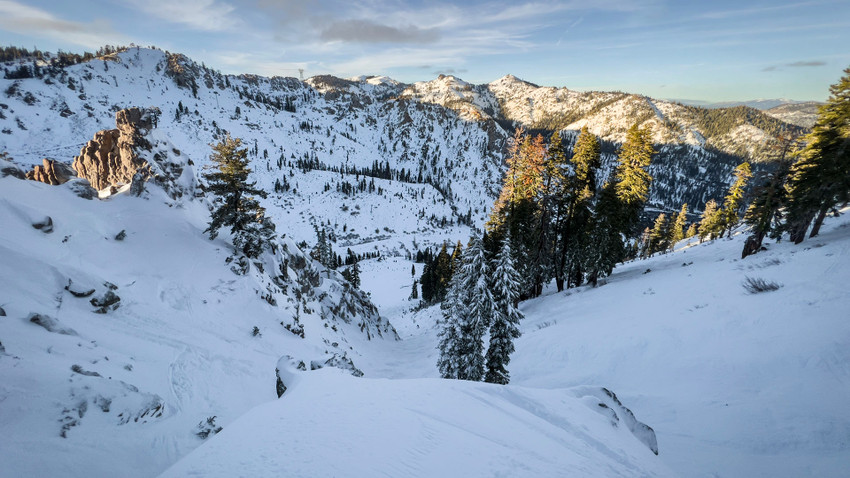
Backcountry skier Ryan Jung, who lives just south of the Monterey Peninsula in California, does a lot of things with his Silky, including using it for snow safety. “When there is enough snow I usually backcountry ski around China Peak dead west of Monterey, in the Sierras,” said Jung. “Sometimes I go to Lake Tahoe and Mammoth, when I can find the time for the drive.”
In areas with avalanches, snow safety is of the utmost importance for backcountry skiers. To test snow safety, skiers often dig a snow pit with a shovel, and then use a saw, typically a large-tooth snow saw, to isolate a column of snow about the size of the avalanche shovel blade–about 8” x 12”. “We cut down to the base of the snow around the shovel freeing that block so that we can get a read on how the force of a skier traversing that block will make the snow react,” explained Jung.
Then it’s time for a tap test. Jung places the shovel blade upside down on the block he sawed away, and taps it with his fingers, then with his elbow, then with his arm until it slides or collapses.
“It’s an objective way to measure snowpack,” says Jung. “It tells you how much force would set off an avalanche. You can get an idea of how dangerous the conditions are, which helps me decide what angle slope I should ski, or if I should head elsewhere and dig another pit in search of a zone that’s more stable and less likely to avalanche.”
Jung used to use a snow saw for cutting his tap test blocks. Now he uses his Silky Gomboy 240. “I had the saw. I was going skiing and needed a snow saw, and I figured why wouldn’t I bring my Silky, which is capable of doing so many things, instead of a saw that can only cut through snow?"
When you’re in the backcountry, your life can depend on what’s in your pack. Jung says that it gives him confidence to have a Silky on hand. “And in addition to cutting blocks to test avalanche conditions, it lets me cut a branch to splint a broken limb or a broken piece of gear, and also cut wood for campfires. When I am on a multi-day trip, being able to build a fire saves weight on fuel. Winter camping trips can be very fuel-intensive because you need to melt snow for water. Also, I often bivvy on winter trips. When I can build a fire, it’s a much more pleasant sleeping experience, and my Gomboy lets me do it all.”
Jung first discovered Silky saws as a rock climbing guide in Ketchum and Stanley, Idaho. “I bought a bow saw for deer hunting, for limbing and cutting shooting lanes in the trees for archery, and it sucked. Then I saw a Silky saw, which was more like a sword, and I had to have one. I quickly learned it’s the chainsaw of hand saws. I started using it for everything.”
“If I have to dig into a snowdrift to make a snow cave, the Gomboy makes it easier to cut the blocks I need.” He also uses the backside of the Gomboy blade as a striker for his ferro rod. “It works a lot better than what comes with your ferro rod,” said Jung.
In the summer, Jung uses his Gomboy 240 to cut firewood when he’s canoe camping and backpacking. He uses it for hunting, and around-the-house projects get done much faster when he has his Silky on hand.
“I can’t believe I went without this thing before,” said Jung. “Silky saws leave other saws in the dust.”