
How Silky Helps Volunteers Maintain Trails for the Appalachian Mountain Club
For Craig Heinselman, his job as North Country Trails Volunteer Programs Supervisor for the Appalachian Mountain Club (AMC), is what he calls a “semi-retirement” job. But Heinselman approaches his position coordinating custom groups, open enrollment events and more with full dedication. “I’m in a unique position at AMC,” said Heinselman. “I’m focused on the volunteer trail side of maintenance on 520 miles of trails we oversee from Pennsylvania to Maine’s 100-Mile wilderness. We do maintenance classes on how to maintain trails. We teach volunteers how to maintain trails. But it’s more than that. We help volunteers understand the nature of trails and hikers, sustainability, and how to make trails more sustainable for the long run.”
That mission to change thinking around trails has shifted how AMC approaches volunteerism, according to Heinselman. He also says that without volunteers–women’s groups, youth groups, diversity groups, and mobility challenged groups, the AMC trails would not be what they are.
There are three rules that Hainselman says govern everything they do at AMC: Every time we do something, be safe, have fun, leave it better.
“We’re working to open the outdoors to everybody. I get to use my 30-year background in operations, quality systems, program management, and facilities that I developed as a mechanical and plastic engineer. It turns out, trail work is a lot of physics and mechanics.”
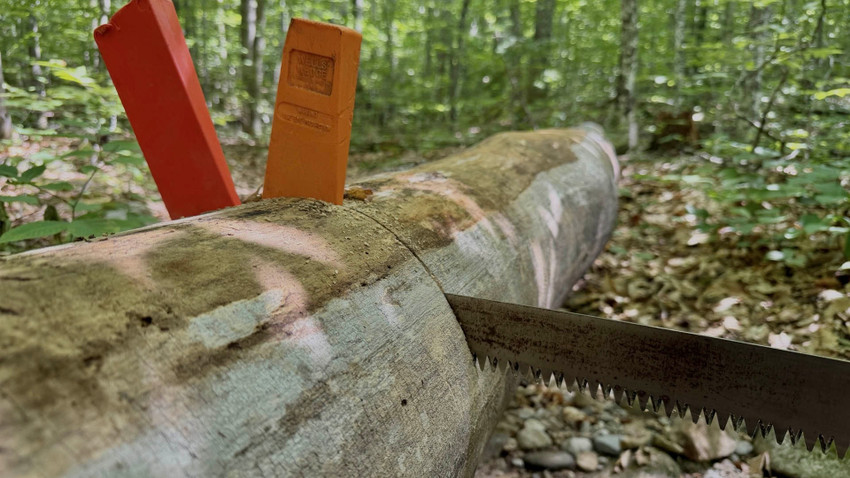
Heinselman has been using Silky saws for many years. After trying numerous brands, he felt that Silky is the best saw for what it does. “The way they’re built and engineered with multi-cutting positions, ergonomic handles, strong and sharp blades.. The design and engineering behind Silkys is exceptional. And I like that you can use them with two hands. It’s safer. You have full control over the saw so you don’t have to worry about the meat of your hand getting into the blade. Silkys cut through every type of tree we need to deal with, whether we’re sawing down a healthy one, or clearing a rotted one that just fell.”
Heinselman praises Silky saws for saving energy because they’re so efficient. And you can cut through some significant trees without a lot of extra tools, like wedges. “Silkys hold up over and over, year after year, even when we’re cutting a few hundred trees a season. They reduce the labor required to do backcountry maintenance. There is no gear, gas, batteries, or chaps required. The cost effectiveness well outweighs the purchase price.”
Heinselman praises Silky saws for saving energy because they’re so efficient. And you can cut through some significant trees without a lot of extra tools, like wedges. “Silkys hold up over and over, year after year, even when we’re cutting a few hundred trees a season. They reduce the labor required to do backcountry maintenance. There is no gear, gas, batteries, or chaps required. The cost effectiveness well outweighs the purchase price.”
To be clear, AMC doesn’t endorse any tools, but they do recommend Silky saws to their trail adopters.
“Getting your first Silky is a right of passage for a lot of volunteers,” said Heinselman. “If they ever buy a tool, it’s lopper, or a saw. And when they hold their own saw, they feel part of it. It’s a Zen thing to cut a tree. Saw therapy. The scent, the smell, the sound. Silkys allow you to have an efficient day out there, and that can’t be beat.”
And it’s not just AMC volunteers who love Silkys when they’re working on the trails. For AMC staff who work in the backcountry, Heinselman says that Silky saws are part of their regular gear. “You might be working five to 10 miles back and clearing a windstorm and have to take out 70 trees in a day. Our Silkys become an expansion of ourselves.”
The saws Heinselman carries most include the Katanaboy 500 or 650, the Gomboy, Zubat, and Super Accel. “The Super accel is so handy. You can strap it, put a biner through it, pass it back and forth if you’re doing high elevation work. It’s nice and light, can handle branches two to three inches, it’s perfect for trimming in the high alpine krumholz.”
Heinselman uses the BigBoy when teaching volunteers how to safely cut a tree.
“You can see undercut with the blade flat. When you get into teaching about tension-compression binds, you can see and feel it with Silly because cuts so smoothly. You can feel when it catches.”
Heinselman routinely carries three to four Silkys at a time, which allows him to approach any situation. “It becomes part of the regiment to do the work in the most efficient manner possible”
He says that most AMC volunteers try Silkys during training exercises. Heinselman and his team keep the volunteer tool crib well stocked with Silkys. This year his team bought a dozen saws, including Gomboys, BigBoys, and Katanaboys. And at their tool HQ at Camp Dodge, they have at least 40 more Silky saws.
The AMC is celebrating 150th anniversary this year. It’s the oldest recreation and conservation organization around according to Heiselman. “We’re not just the hut people! We do a lot with trails, policy, conservation, and research. And how we combine it into one entity is impressive in the industry. At any given time, we could have a dozen professional crew and hundreds of volunteers on the trails, Having tools that are reliable that we can go back to over and over again is key for our success. And we keep going back to Silky.”