
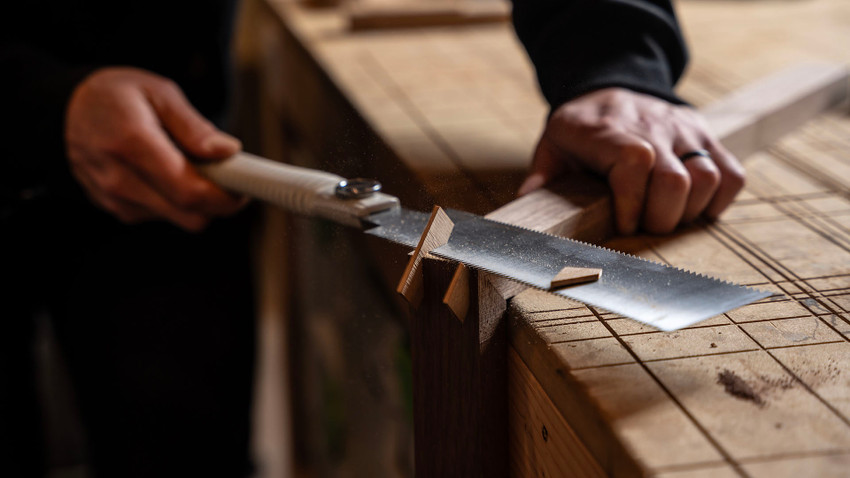
Dylan and Wesley Harkavy depend on the Hibiki to make fine furniture
“I’m a big fan of Alone,” said Wesley Harkavy. “That’s where I first saw Silky saws. Everyone on the show carries a Silky. Dylan and I do a lot of fishing and camping. We always had cheap, dinky saws that were dull after one trip. I was geeking on Silky saws as we were prepping for a camping and steelhead fishing trip, and we decided to swap our disposable, folding Amazon special for a Silky Bigboy. It was a game-changer. Now we use it all the time when we go camping. Once a month, we burn our woodworking scraps on the edge of the woods beyond the shop. We use the Bigboy to knock down a few dead trees and cut rounds for the base of that fire. When we’re fishing, we use it to cut wood for campfires, and occasionally to build a lean-to that’s totally unnecessary. The Bigboy is a machine.”
“Our furniture requires a lot of unique, tight kerf cuts where metal meets wood,” said Dylan. “We strive to make those interactions seamless, but the biggest drawback with using a track saw is that the cut is always curved at the end. We’ve always been more power-tool focused woodworkers, and when we weren’t able to make fine cuts we figured it was user error.”
“The Hibiki is the type of tool you don’t know you need until you need it,” said Wesley. “This is a saw that can get into a small space where a power tool can’t. The cut quality is so smooth, and the saw is so much more enjoyable to use than anything else we’ve tried.”
“When we’re cutting a super thin kerf, being able to do the bulk of that cut with the circular saw and then finesse the finish with the Hibiki gives us the best final result,” said Dylan. “We’re working to 1/32 inch. With a clunky circular saw, we can only get to within ¼ inch of our ideal. The Hibiki gives us a totally different level of control.”
“We have a small shop,” said Wesley. “It’s a converted two-car garage and half a barn. When we need a tool, we have to take it out and put it away. We don’t have the space to leave all of our power tools set up. The Hibiki lives in the center of our shop next to the pencils and safety glasses. To make a cut with the Hibiki takes 10 seconds. To set up the track saw and make a cut takes 10 minutes. So the Hibiki is a big time saver.”
The Harkavy brothers are self-taught. “We were homeschooled,” said Wesley. “Growing up, we had a tiny woodshop in the basement with our dad’s old power tools. We wasted hours building stuff. Then we built our own skateboards and longboards. We were too cheap to buy as many boards as we would break, and that’s ultimately what really got us into woodworking.”
“Fast forward again,” said Dylan. “When our folks moved, we built our mom a big outdoor dining table for Mother’s Day. Our parents outgrew it in a year, so we built a new table for our parents and posted the original on Craigslist. We sold the table, and also got multiple requests for custom tables.”
“I was going to school for interior design at the time,” said Wesley. “I was deep in the interior design and architecture worlds. Dylan was a photographer and involved in fine arts. We started building custom tables for Craigslist customers. Eventually, we got to a point where we quit our jobs. I left interior design school, and we launched our first line of two coffee tables and two dining tables. I was 19, and Dylan was 21. We thought it would be fun. We had no idea what we were doing.”
“I shot our furniture in a studio using a painter’s tarp for background, and I started direct messaging design firms on Instagram,” said Dylan. “We had 100 followers. I got no responses. Then one day we woke up and Design Milk had posted our collection. We had 1400 followers overnight, and emails/inquiries from Miami, Dubai, Turks and Caicos, and Japan wanted information on how we ship, lead times, and more. We had four tables in stock. It was incredibly flattering, and we were nauseous with anxiety. We quickly figured out what white glove shipping is and how to do it. But we lost money for a while because we had no idea that it cost $800 to ship a table to the East Coast. We were fine-tuning pieces the night before they were supposed to be picked up and shipped. We had no idea how to price our tables. We were building out of a shop on our parents’ property that barely had a garage door. All the while, those pieces kept gaining traction through the Zine, Touch of Modern, and others. We realized we’re in this whether we want to be or not.”
It took the Harkavy brothers three years to dial in their pricing, lead times, client management, and setting up a proper shop. They officially launched Portland-based Harkavy Furniture in 2016, took a brief break post-COVID, and now they’re back at it. Both brothers are in their 30s and say that being more experienced in life and business management has made making and selling high-end furniture more enjoyable while still letting them spend maximum time together, which is foundational for both of them.
“Wesley and I have always been best friends,” said Dylan. “We shared friend groups growing up. If we don’t hang out every day, it’s a weird day. If the business ever gets in the way of us being best friends, we’ll need to change course. But for now, what we share working together is a magical thing. We balance each other.”
“The Hibiki has given us the desire to build more by hand and to do even finer work,” said Wesley. “We have incredible respect for master woodworkers, and we’re not those guys, but we’re always curious to learn how to do things better. The Hibiki has helped us refine our craftsmanship and has opened the door to trying new things, for learning, for new joinery.”
Check out Harkavy Furniture harkavyfurniture and
Photography by Dylan Harkavy dylanharkavy on Instagram